Topps UCC Gold 2025-26 UK Resell Guide
Topps UCC Gold 2025-26 hobby box: UK resell prices, eBay fees, autograph value, and timing your flip. Real numbers, no hype, for United Kingdom resellers.

In the spring of 2026, a United Kingdom eBay seller listed a confirmed pre-order for a Topps UCC Gold 2025-26 hobby box before the product had even been manufactured. The listing sold. Then another one did. On a single listing, 47 boxes changed hands and 134 watchers were tracking the price in real time. That is not hype; that is a live secondary market operating in a fulfilment gap, and it tells you something concrete about how UK resellers are treating this release.
Inside the Hit The Drop Discord, UCC Gold has come up as the tier members are least clear on within the full Topps UEFA Club Competitions stack this season. Members who have navigated Museum, Chrome, Sapphire, and Finest all have questions about where Gold sits, whether the print-to-order model changes the calculus, and whether securing an order now still makes sense at this point in the cycle. This guide is my attempt to answer those questions properly, with real numbers and no fluff.
What Is the Topps UCC Gold 2025-26 Hobby Box and Why Does It Matter for UK Resellers?
UCC Gold is not a standard Topps hobby release. It is an online-exclusive, print-to-order product sold only through the official Topps store during a fixed sales window. This year's edition features an artist collaboration with Jean Bronner (also known as LJ Stration), a French artist whose distinctive visual style is applied across the card designs. That collaboration is new for 2025-26 and is a genuine differentiator from the prior year's edition.
The print-to-order mechanic is the detail that matters most for secondary-market analysis. Topps applies a production cap, but because every order placed during the sales window is fulfilled, the final print run is not published and not known until the window closes. That uncertainty is precisely what created the arbitrage window you saw play out on eBay in the spring of 2026.
The UEFA Club Competitions licence covers the full depth of European club football, which is the sweet spot for UK collectors. Legacy autograph signers combined with current Premier League and international stars make this a product with broad demand across age groups. For a UK reseller, that breadth of buyer appeal matters because it widens the pool of potential eBay purchasers for individual hits.
If you want context on how UCC Gold sits within the wider Topps UEFA product calendar, our Topps Chrome UEFA 2025-26 hobby box UK resell guide covers the Chrome tier in detail, and our Topps Museum UCC 2025-26 hobby box UK resell guide covers the premium Museum tier.
Retail Price, Box Contents, and the Print-to-Order Model Explained

The retail price for the 2025-26 edition is £175 per box, up from £160 in 2024-25. That is a 9.4% year-on-year increase in the cost of entry, according to Checklist Insider's full product breakdown. Before you model any resell margin, that £175 is your baseline cost of acquisition, and it has to be recovered before a single penny of profit exists.
The critical question is whether secondary-market premiums have kept pace with the retail price increase. Based on the pre-order activity visible on eBay UK in early 2026, demand was clearly there, but a £15 rise in retail cost compresses the margin at every price point unless the resell price has moved by at least the same amount. That is not guaranteed, and anyone telling you it is guaranteed is not being straight with you.
This is also worth stating clearly because it is easy to confuse UCC Gold with the standard Topps UCC hobby box. They are separate products. The standard UCC hobby box (released January 2026) runs to 24 packs of 8 cards with one guaranteed hit. The UCC Gold box contains 40 cards and guarantees two autographs. The higher auto yield per box is part of what justifies the premium retail price and what drives secondary-market demand for sealed product.
The parallel rarity ladder is where individual card resell value is determined. According to Checklist Insider, the ladder runs: Blue /99, Green /75, Purple /50, Orange /25, Black /10, Red /5, and Gold 1/1 at the apex. As a general rule, anything /10 or tighter will command a meaningful secondary premium in the UK market. A Gold 1/1 of the right player can return multiples of the box cost on its own, but the realistic pull rate for those ultra-short prints is low. Expected value (EV) analysis on a single box is genuinely difficult to pin down as a result.
Understanding your true cost structure before committing capital is the foundation of treating reselling as a business rather than a punt. For a broader primer on that discipline, the guide on how to run reselling like a real business is worth your time.
Current UK Resell Prices: What eBay Sold Listings Tell Us
The confirmed pre-order activity on eBay UK in the spring of 2026 was real and significant. Sellers were listing confirmed orders for boxes that had not yet shipped, and buyers were paying a premium over the £175 retail price to secure one. The 47-unit sales volume on a single listing is not a trivial number for a product in this price bracket. It indicates that a segment of the UK collector market was willing to pay above retail specifically to avoid the risk of missing out during the sales window.
For a UK reseller, that pre-order flip is a legitimate strategy, but it carries its own risk profile. You are asking a buyer to wait several months for physical product, and you are carrying the reputational and logistical obligation of a confirmed order. If Topps delays fulfilment or if secondary-market prices drop before boxes ship, the pre-order premium you charged may evaporate. You cannot return your commitment to Topps once the sales window closes.
For context on how the authorised retail purchase experience compares, Sports Cards Direct offers same-day dispatch before 2pm, a 30-day return window on unopened sealed stock, and Klarna/Clearpay payment options. Buying from an authorised retailer gives you buyer protections that an eBay private-seller listing does not provide.
eBay Seller Fees: Smaller Than Most Guides Claim
This is the number almost every product breakdown gets wrong, and the error always cuts the same way: it makes the flip look less profitable than it actually is. Since 1 October 2024, private sellers on eBay UK pay no selling fees on domestic sales - no final value fee, no per-order fee. Instead, the buyer pays a Buyer Protection Fee on top of the item price, the same model Vinted uses (eBay's own seller guidance confirms this).
In practice, that means selling a £200 box as a private seller costs you next to nothing in platform fees - a few pounds at most once you account for postage and packaging, and nowhere near the £25-odd that an old percentage-plus-per-order model would have implied. Your real deductions are postage, packaging, and your own time. Model those, not a phantom fee, and the margin picture looks considerably healthier.
The maths only shifts if you sell as a registered business seller (business sellers do still pay final value fees) or if you pay for optional listing upgrades. For the typical member flipping the odd box or a hit from a personal break as a private seller, the headline is simple: eBay is not taking a chunk out of your sale the way it used to.
The Secondary-Market Premium Over Retail
The print-to-order scarcity model creates genuine pricing uncertainty in the weeks before fulfilment. Because the true production volume is not published, buyers cannot know whether scarcity will be extreme or moderate. That uncertainty tends to inflate pre-order premiums. Once boxes start shipping and breaks flood YouTube and social media, the information asymmetry collapses and prices often reset toward a more rational level. The direction of that reset matters for when you sell.
Which Cards Drive the Most Resell Value in the UK Market?
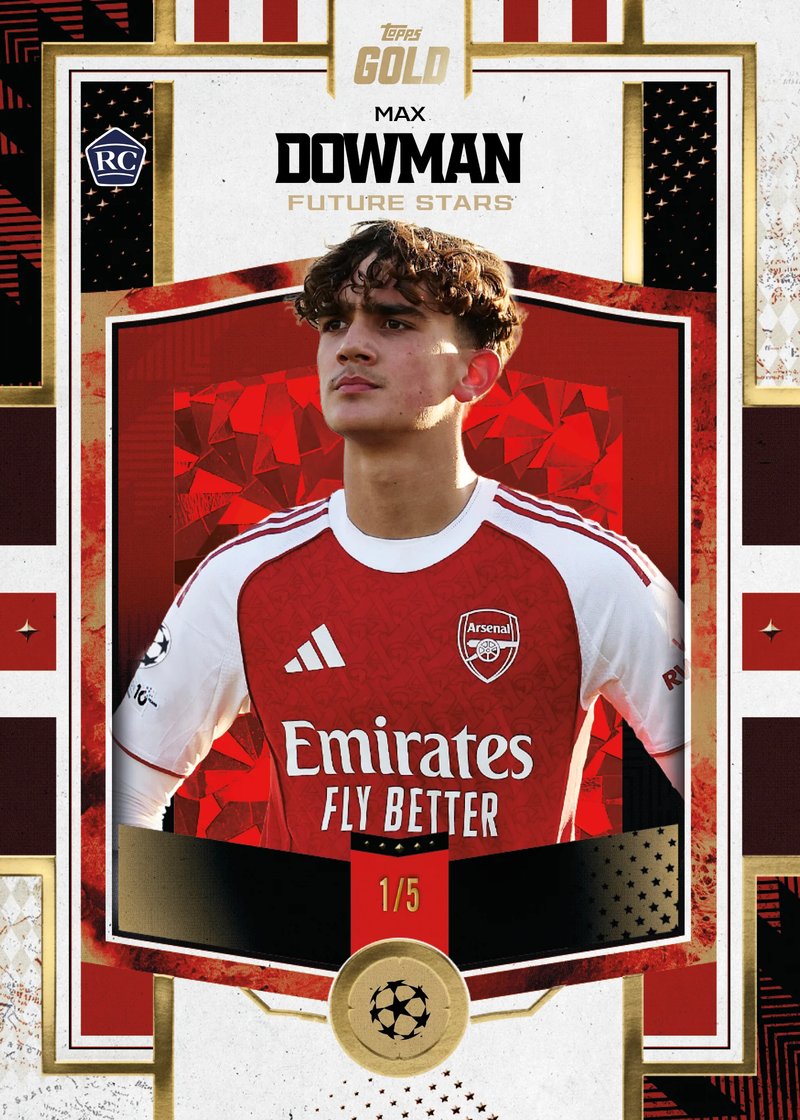
The Golden Greats autograph set is the headline value driver in UCC Gold. The confirmed signers include Ronaldinho, Zinedine Zidane, Thierry Henry, Kaka, and Marco van Basten. These are players whose cards have demonstrated consistent secondary-market demand for years, and their appeal cuts across generations of UK collectors. A Henry or Zidane on-card auto in a tight numbered parallel is the kind of pull that comfortably exceeds the box cost on its own.
Messi autographs are in a category of their own. His cards in any Topps UEFA product generate immediate interest at box-break, and numbered parallels trade quickly. Beckett's deep-dive into the UCC autograph checklist confirms the Marks of Excellence on-card signature set as the flagship auto product within the range, and that is where Messi sits for collectors who care about the distinction between sticker and on-card autos.
Beyond autos, the Midas insert set and the numbered Gold 1/1 parallels are the secondary-value anchors within a box. Midas inserts in tight print runs attract collector attention because they combine the visual identity of the Gold product with genuine scarcity. A Gold 1/1 of any player with an active UK following is essentially its own auction event when it surfaces on eBay.
The Aurea subsets and standard-numbered parallels (Blue /99 down to Red /5) represent the volume of what most boxes will yield. Understanding which tier of the rarity ladder you are likely to encounter in a given break is essential for setting realistic expectations on per-break return.
UK Collector Demand for England and Premier League Stars
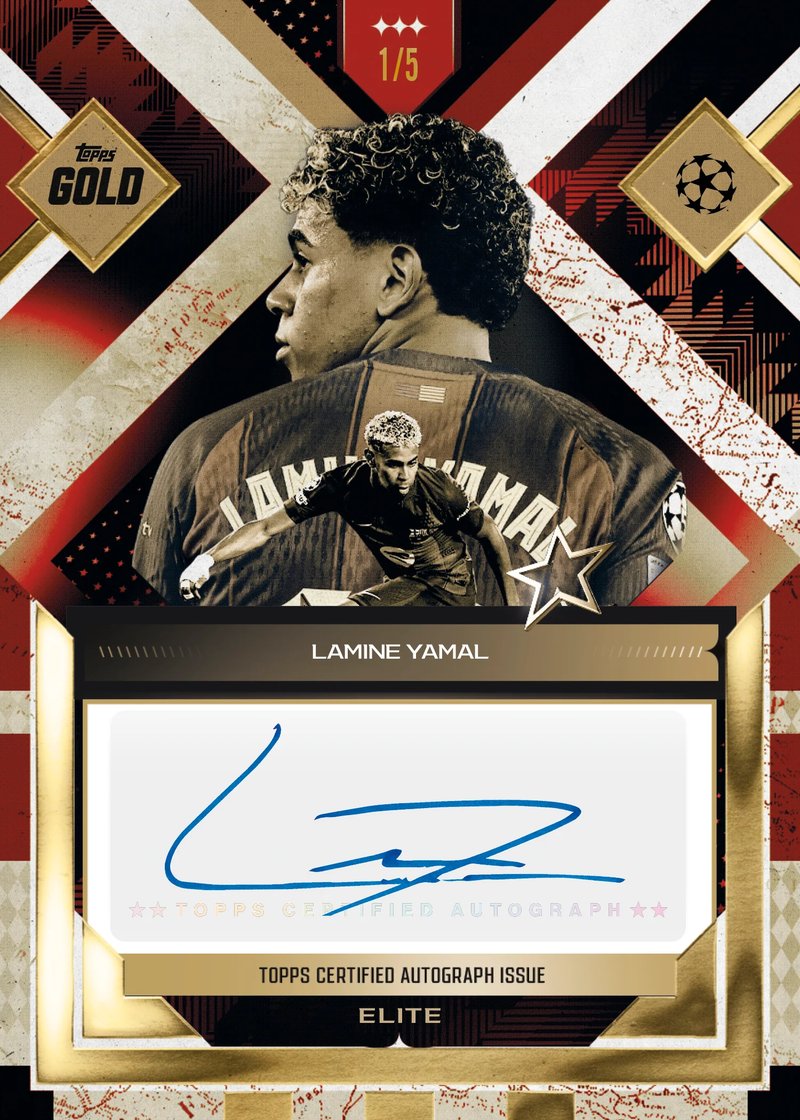
As a UK reseller, your buyer base has a regional demand premium for specific players. Cole Palmer, Bukayo Saka, Harry Kane, and Lamine Yamal all command elevated prices in the British secondary market relative to their global average. Yamal in particular has seen sharp price appreciation across all Topps UEFA products following his performances in the 2025-26 Champions League season.
When you list individual hits from a UCC Gold break, titling and tagging your eBay listings with the specific player name, the parallel colour, and the print run number will significantly outperform generic listings. UK buyers search specifically; generic listings get scrolled past. This is basic eBay optimisation, but it is the difference between a three-day sale and a three-week wait.
How to Time Your Flip: Pre-Sale, Ship Date, and Post-Break Windows
The pre-order flip window is the highest-risk, highest-potential-premium stage. Sellers who listed confirmed orders earlier in 2026 were asking buyers to accept a multi-month wait for physical product. Few buyers do that without a premium to compensate for the delay and the counterparty risk. If you secured an order early in the sales window and listed it immediately, you were competing with others doing the same thing, which compresses the premium over time as more listings appear.
The 26-28 business-day shipping window after the sales window closes (confirmed by Checklist Insider) means that boxes ordered toward the end of the sales period could be arriving in June or July 2026. If the UCC Chrome release or Finest has generated more buzz by then, buyer attention and capital may have shifted. Product calendar awareness is not optional if you are making decisions about where to deploy money.
Risk and Opportunity at Fulfilment Time
The moment boxes start shipping is typically when the most price-efficient resell window opens for sealed product. The product is confirmed, physical, and in hand. Buyers can purchase with confidence. Pre-order risk is gone. But so is the pre-order premium. Sealed box prices at fulfilment time tend to reflect a more rational assessment of break odds, especially once the first wave of YouTube breaks has given the market a clearer picture of pull rates and hit quality across the print run.
If you are buying at retail to flip sealed, the fulfilment window is where you need a clear margin model - and a realistic one. At £175 in, and with no eBay selling fees as a private seller, a £200 sale leaves roughly £25 of gross margin before postage. If you secured the box through the HTD ACO, take off the pay-after-success fee - on a box like this that works out at around £5 (20% of the projected ~£25 margin, charged only on a confirmed cop) - and you are still net positive before you have opened a single pack. There is genuine margin in these boxes after fees. A meaningful secondary-market premium over retail (not guaranteed) or selling individual cards out of a break both push the return higher from there.
Post-Break Hype and Secondary-Market Saturation
Post-break is where individual card values are set, but it is also where sealed box prices tend to soften. Once the break community has established which pulls are landing and at what frequency, the mystery premium on sealed stock evaporates. Buyers who missed the breaks can now look at completed eBay listings and price sealed boxes with much more information than they had pre-ship.
For UCC Gold specifically, the post-break window is when Golden Greats autos and Gold 1/1 parallels will surface at auction and set price anchors. If you hold a strong hit from a personal break, listing it in the two to three weeks immediately after boxes ship (while break content is fresh on YouTube and Instagram) is typically when demand peaks before the market normalises. Timing that window requires monitoring, not guessing.
The HTD community tracks this kind of timing across the full Topps UEFA stack. For a comparison of how UCC Gold sits relative to the Chrome Sapphire tier, the Topps Chrome Sapphire UCC 2025-26 UK resell guide covers that product in the same analytical framework.
Running This Properly: Systems, Costs, and Community
The operators who make consistent returns from products like UCC Gold are not guessing. They track cost per box, postage and packaging per sale, and margin per card sold. They know the product calendar well enough to anticipate where buyer attention will be in six weeks. And they have a community to sense-check their read on a release before committing capital.
If you want to do this properly, the Hit The Drop community is built for UK resellers who operate that way. The ACO (automated checkout) service runs on a pay-after-success basis, meaning a percentage fee on the projected margin applies only when a checkout actually lands. There are no upfront charges for the ACO, and there are no income guarantees, because those guarantees are not real. The model is straightforward: when members succeed, Hit The Drop succeeds. When they do not, neither does HTD.
Beyond ACO, the community covers mass raffle entry, residential and ISP proxy infrastructure, and Amazon account generation for members working across multiple drop types, including TCG, sneakers, and Funko alongside trading cards. It is a toolkit for treating reselling as a business, not a series of punts.
If that sounds like the right environment, request community access and see what the infrastructure looks like from the inside.
🧡
Sources
- https://www.checklistinsider.com/2025-26-topps-gold-uefa
- https://www.beckett.com/news/2025-26-topps-uefa-club-competitions-soccer-cards/
- https://www.sportscardsdirect.co.uk/products/topps-ucc-gold-2025-26
- https://www.ebay.co.uk/help/selling/selling/pricing-items/buyer-protection-information-sellers?id=5595
Skip the queue
Use HOTWIRE as your referral when you join Hit The Drop for instant approved access, no member vouch needed.