Sell-Through Rate: Which UK Drops to Enter 2026
How to use sell-through rate to decide which UK drops to enter in 2026. A practical operator's guide: eBay data, STR thresholds, ACO strategy and fee-adjusted.
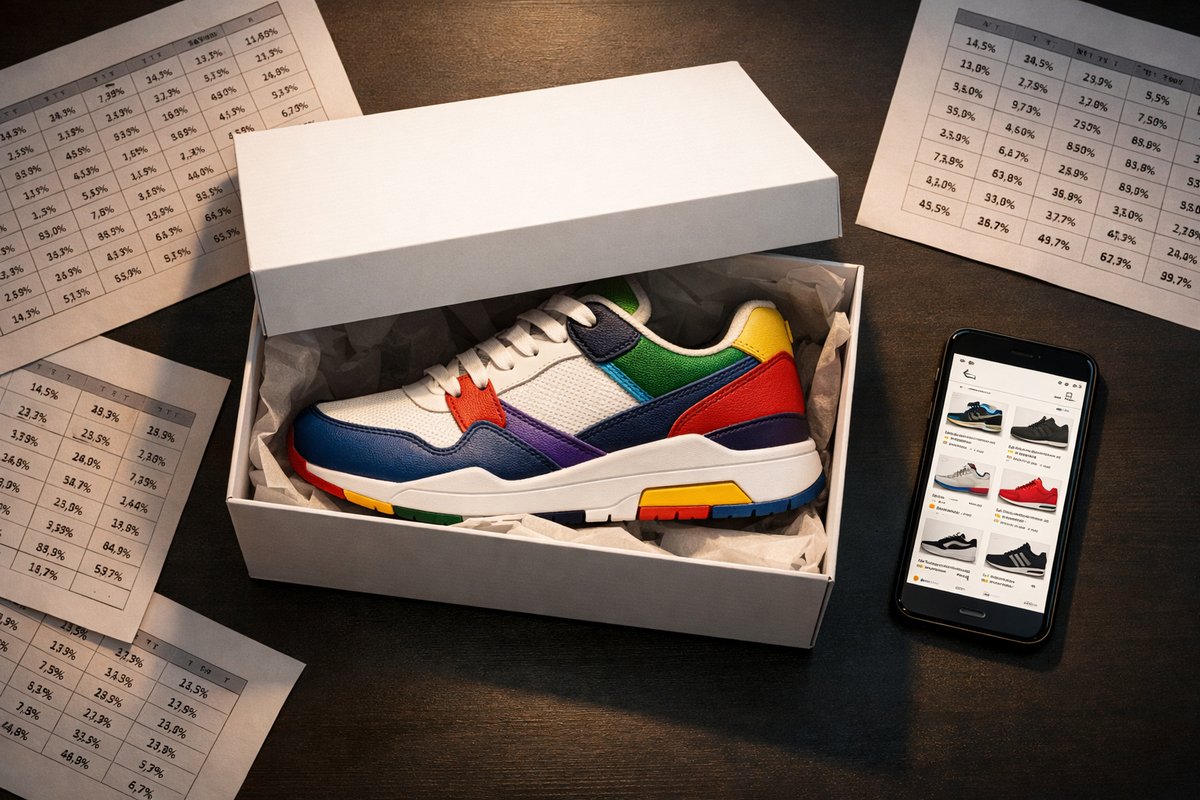
You spot an upcoming drop on The Sole Supplier's UK raffle calendar. The hype looks real. Your group chat is buzzing. The question is whether that energy translates into an actual sale at a margin that makes the entry worth it. In the United Kingdom, where platform fees, post-Brexit customs friction, and courier costs all chip away at your net, entering a drop without checking the secondary-market sell-through rate first is one of the most avoidable mistakes a reseller can make.
Sell-through rate (STR) is not a retail concept bolted onto reselling. Used correctly, it is the single most useful pre-entry filter you have. This post walks through what it means in a drop context, how to calculate it in under five minutes using eBay UK data, and how to build it into a repeatable decision framework across sneakers, TCG, and Funko.
What Sell-Through Rate Actually Means for Drop Resellers

STR measures how much of the available supply actually sold, expressed as a percentage. The formula is simple: sold listings divided by total listings, multiplied by 100. If 80 pairs of a colourway were listed on eBay UK in the past 30 days and 56 of them sold, the STR is 70%.
According to MyListerHub's analysis of eBay sell-through data, the average STR across all eBay categories sits at roughly 33%. That means the typical listed item has a one-in-three chance of selling at any given moment. For limited-run drop products, your baseline expectation should be well above that. If a recently dropped item is sitting at or below the 33% average, that is a warning sign, not a buying signal.
Shopify's UK retail guidance sets a useful benchmark: for short-life or seasonal products where replenishment is not possible, a 30-day STR above 80% is the target. The logic applies directly to resellers. If a drop colourway cannot clear 80% of listed pairs within a month, the exit window is narrowing fast, and post-release price decay will compress your margin further.
Here is how to pull the number yourself using eBay UK. Search for the specific item (colourway, size, and condition). Filter to completed listings covering the past 30 days. Count the green "Sold" results and the total listings. Divide sold by total, multiply by 100. That is your STR. Tools like Terapeak (built into eBay's Seller Hub) can surface this data faster if you sell on eBay regularly, but the manual method works for a one-off pre-entry check and takes about five minutes once you have done it a couple of times.
One size-specific note: men's UK 8 to 10 (US 9 to 11) are consistently the most liquid sizes on secondary markets and tend to command the strongest premiums. Very small or very large sizes sit longer and may produce a misleadingly low STR for a shoe that is actually in strong demand at mid-sizes. Always filter your eBay search to a specific size, not just the colourway.
The Three UK Drop Mechanics and How Each Changes Your Risk Profile

Before you apply an STR filter, you need to understand what you are actually entering. UK drops run on three main mechanics, and your realistic success rate differs significantly depending on which one applies.
First-come, first-served (FCFS). These are the classic site-traffic races: the drop goes live at a set time and whoever completes checkout first wins stock. On major releases, FCFS drops are dominated by automated checkout bots. EQL's explainer on sneaker bot mechanics confirms that FCFS bots execute purchase attempts in milliseconds, making manual entry near-impossible on high-demand FCFS drops. For ordinary UK resellers without ACO infrastructure, FCFS on major releases is not a realistic opportunity.
Raffle format. Retailers including Size?, End Clothing, Offspring, Footpatrol, and JD Sports use raffle mechanics to gate limited releases. You enter before the close date, and winners are selected randomly. The playing field is considerably fairer for non-bot entrants, particularly on boutique raffles with smaller entry pools. The Nike SNKRS LEO (Launch Early Order) draw operates similarly, though entry volumes are far higher. If you want to understand realistic odds on SNKRS-style draws, the How Many Entries Win a Nike Raffle UK guide breaks down the real numbers.
Automated checkout (ACO). ACO is the tool that levels the playing field on FCFS drops, and on raffle drops it increases the volume of entries you can submit cleanly. At Hit The Drop, ACO runs on a pay-after-success basis: the fee is a percentage of the projected margin on that item, and you only pay when a checkout actually lands. That alignment matters. If the drop does not convert, there is no fee. But ACO does not change the underlying demand picture for the item. It improves your odds of securing stock; it does not guarantee that stock will sell above retail once you have it. That is exactly why STR screening should come before you decide whether to involve ACO at all.
How to Use STR as a Go or No-Go Filter Before Any UK Drop in 2026
The practical decision rule is straightforward. Run your STR check first, then decide on entry method and capital commitment.
Above 80% STR in 30 days: Strong signal. Secondary-market demand is absorbing supply quickly. This is the tier where investing in ACO on an FCFS drop, or entering at scale on a raffle, is justified by the data. Even here, account for fees before you commit. See the margin section below.
50% to 79% STR: Moderate signal. The item sells but not rapidly. For FCFS drops this tier warrants caution, because your holding period extends and price decay begins within weeks of launch. For smaller boutique raffles where entry is free and the win rate is meaningful, a 50-plus percent STR can still be a reasonable entry, but size your position accordingly.
Below 50% STR: Weak signal. Even a free raffle entry carries meaningful dead-capital risk if you win. If you secure stock in this bracket, you may be holding it for months, selling below your target price, or taking a loss after fees. The 33% eBay average is a useful reminder: most listed inventory never sells. A sub-50% STR on a hyped drop means the hype and the data are telling different stories. Trust the data.
Off-White is a useful real-world benchmark. Analysis of Off-White's 2026 secondary-market performance places the brand's 30-day STR at around 72% across major resale platforms, with collab sneakers and the Industrial Belt moving fastest. That 72% figure sits in the moderate-to-strong bracket: solid enough to justify entry on the right colourway, but not automatic. A specific Off-White colourway in an unpopular size could still underperform the brand average.
The same STR approach applies outside sneakers. For Pokemon TCG, pull eBay UK completed listings for the specific sealed product (booster box, ETB, or bundle) you are targeting. For Funko, filter by the exact variant. The formula does not change. If you want a worked example for a specific TCG product, the How to Price Limited Edition Resale Items UK guide walks through the comparable sales methodology in detail.
One further timing point: secondary-market price data shows that resale prices typically spike immediately after a drop sells out, then decline steadily over the following weeks as more pairs enter the market. A high STR at 30 days is a stronger signal than the same STR measured at 90 days, because 30 days reflects genuine near-launch demand rather than a slow trickle of late sales. When you pull your eBay data, always check the date range.
Realistic Success Rates, Fee-Adjusted Margins, and Why Only 47% of Releases Now Trade Above Retail
The market context for 2026 matters here. Analysis of Q2 2026 sneaker release data shows that only 47% of new releases now trade above retail, down from 58% in 2020. That means entering a drop without a pre-entry STR check gives you roughly coin-flip odds on profitability, before fees.
Fees are not optional to consider. StockX's fee structure starts at 9% seller fee plus a 3% payment processing fee, totalling 12% before shipping. On a Jordan Retro purchased at £180 retail, you need to clear roughly £202 to £210 just to break even after platform fees and postage, before accounting for any ACO or entry costs. That compressed margin means an item with a 60% STR at a 10% premium over retail may not actually be worth entering when you do the arithmetic.
For UK resellers selling into European markets, post-Brexit customs friction adds another layer. Platform routing analysis for 2026 notes that Brexit-related import duties create friction for UK-to-EU buyers, affecting both sell-through speed and achievable price. Klekt cut its seller fees to 11% in 2026 partly to capture European share from StockX, which makes it worth factoring into your platform routing decision. But the customs friction itself remains. If your exit strategy relies on EU buyers, build that into your margin calculation.
The eBay and Vinted Fees UK 2026 guide covers the specific fee stacks on those platforms in detail, including the real-margin impact that most resellers underestimate.
On the positive side, StockX's January 2026 Current Culture Index reported that nearly 200 brands set all-time annual sales records on the platform in 2025, and forecast 2026 demand to be lifted by the FIFA World Cup, the Milan Olympics, and Bad Bunny's adidas signature launch. Football-adjacent and sports-collab drops are likely to produce higher STR readings in the second half of 2026. That is the category context to watch when screening upcoming UK drops.
Building a Repeatable Drop-Entry Framework for UK Resellers

Running this as a business means making the same disciplined decision every time, not just on the drops you are excited about. Here is the framework I use at Hit The Drop, compressed into a repeatable sequence.
Step 1: Identify the drop and its mechanics. Start with The Sole Supplier's raffle calendar to confirm whether a UK drop is raffle-gated or FCFS, and which boutiques are carrying it. This tells you what entry method is relevant before you spend time on research.
Step 2: Pull a 30-day eBay UK STR for the specific colourway and your target size. Set the 80% threshold as your strong-entry signal. Below 50%, treat the drop as speculative regardless of the hype.
Step 3: Calculate fee-adjusted break-even. Take your expected resale price (based on current eBay sold comps), subtract all fees (platform, ACO if applicable, postage), and confirm the margin is real before committing. A high STR at a thin margin is still a marginal opportunity.
Step 4: Match the entry method to the risk profile. High-STR FCFS drop? ACO makes sense and the pay-after-success model means your cost is tied to a real outcome. High-STR raffle with small entry pool? Enter at scale and use the raffle entry service if the product justifies it. Low-STR anything? Walk away and protect the capital for the next opportunity.
Step 5: Record everything. STR at entry, entry method, success or fail, actual sale price, net margin. Over time this record is the data that improves your own decision-making, because you will see which product categories and which boutiques actually convert for you. The Track Reselling Inventory and Profit UK guide has the spreadsheet setup to make this simple.
Consistency across many drops is where the edge accumulates. Not one mythical hit, not chasing every piece of hype, but a steady process of entering the right drops at the right time with the right tools and walking away from the rest.
If you want to build that kind of operation properly, Hit The Drop exists as a UK Discord-based reselling community where operators share what actually works, alongside an ACO service that earns only when you do. Apply to join if you are serious about running this like a business rather than a side hobby.
🧡
Sources
- https://www.shopify.com/uk/blog/sell-through-rate
- https://www.mylisterhub.com/articles/ebay-sell-through-rate
- https://hypeproxies.com/blog/sneaker-reselling-stats
- https://ballerstatus.com/fashion/sneaker-market-crash-2026-resale-analysis/
- https://www.underpriced.app/blog/is-off-white-worth-reselling
- https://www.eql.com/media/sneaker-bots-101
- https://thesolesupplier.co.uk/raffles/
- https://pagecrawl.io/blog/sneaker-release-calendar-automated-alerts
- https://sneakerscartel.com/the-definitive-guide-to-reselling-your-sneakers-in-2026/
- https://closo.co/blogs/data-driven-insights-market-analytics/the-truth-about-every-major-sneaker-marketplace-in-2026-where-to-actually-sell
Skip the queue
Use OVERCLOCK as your referrer when you apply to join Hit The Drop and you skip the waitlist with access approved straight away.